1960 – 1970
In the mid-1950s, large numbers of people in their 20s and 30s, their prime working years, migrated to the big cities to become the driving force behind Japan’s post-war era of rapid economic growth. This meant that it fell on the women and the older folk to carry on struggling with the heavy load of farm work that they left behind. Keenly aware of this situation, Honda undertook the development of a multi-purpose tiller that could much more easily be used by women and older people. Fueled by the inspiration of total innovation in creating something new that had never existed before—something that would be ten years ahead of its time—Honda came out with its first tiller in 1959, which it called the F150.
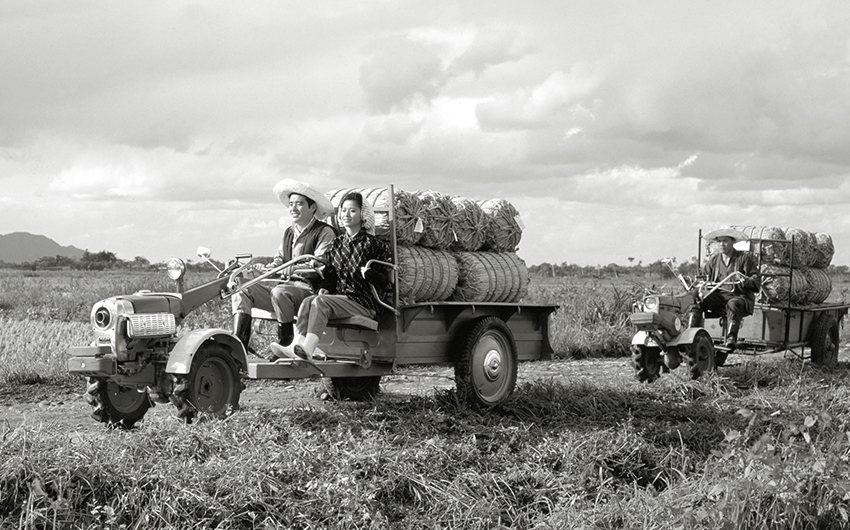
The F150 series tillers set off a Honda whirlwind in Japan’s rural areas.
Compared to previous tillers, the F150 was compact, lightweight and remarkably easy to use while achieving a highly versatile functionality combined with rugged durability. Even in its styling, the F150’s mechanical parts were fully covered, its modern bodywork coated in a distinctive bright red body color.
At the time, Japan’s total tiller market added up to only a few thousand units per year. However, the F150 recorded explosive sales as soon as it was released, and within the farm equipment industry it soon came to be called the ‘Honda whirlwind.’ Over 20,000 units were sold that year, and production continued for another 13 years with gradual improvements along the way. For farms that had been suffering from an acute shortage of labor, the compact, red Honda tiller proved to be an innovative agricultural machine that revolutionized Japan’s farm work environment.
The next item Honda set out to develop was a portable generator. This was inspired by Sony’s recent invention of a transistorized portable television. Sony needed a power source that would allow it to be used anywhere, and Honda was singled out to undertake development of a portable generator that could be carried by hand.

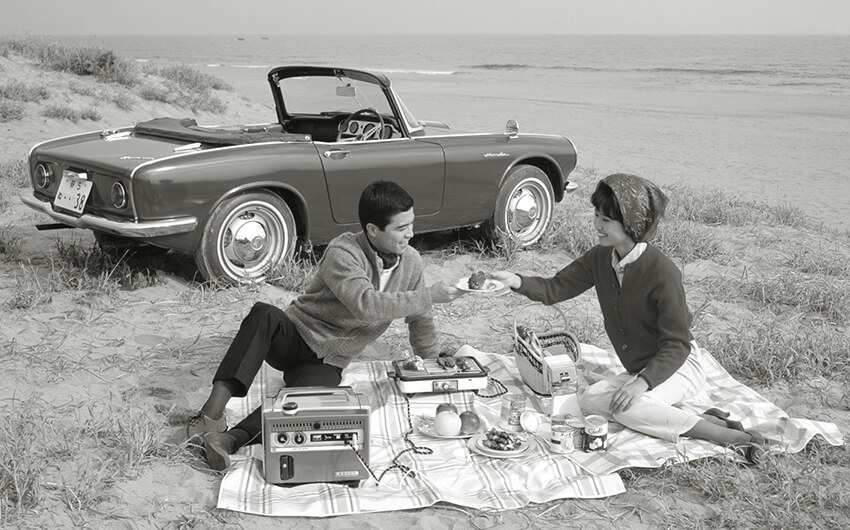
The compact E300 portable generator was busy in all sorts of scenes.
Although its prototype never reached full production, the knowledge gained from its development was soon used in the development of later models of portable generators, and three years later Honda released the E300 compact portable generator. While ordinary generators of the time were often complicated and hard to start and operate, the little red E300 was small, lightweight, and simply looked easy to use. Just as new electrical devices were gaining popularity in Japan, the E300 marked the arrival of a portable power supply that anyone could use.
The sheer convenience of this compact, quiet and smoke-free generator caused generator sales to skyrocket, whether on construction sites for use in lighting where night work had increased, or as backup power sources, or even among the general populace providing electrical power for outdoor lighting or nighttime food stalls.
By the mid-1960s, Honda had become the dominate player in motorcycle World Grand Prix racing, leading to increased exports of its production motorcycles. Honda also began competing in Formula One racing soon after the release of its first production cars, the T360 mini truck and S360 sports car. Just as with the timing of its tillers and generators, Honda began to set its sights on the worldwide distribution of its general-purpose products, and soon reached an important turning point in its quest for globalization.
As the nations of Southeast Asia were beginning to modernize and develop, they soon found need for cheap yet durable power sources. European or American diesel and two-stroke engines were already in wide use in Southeast Asia at the time, but Honda figured that it could supply cleaner and more compact 4-stroke engines that offered excellent performance and durability.
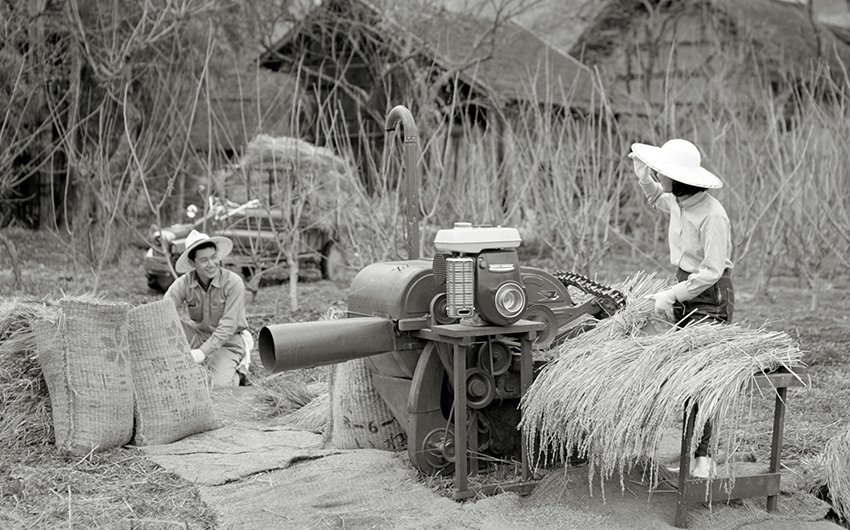
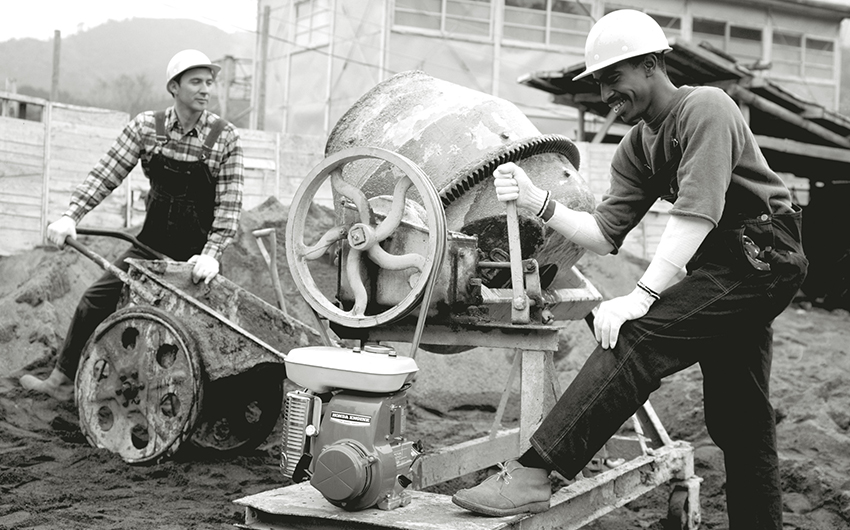
Honda’s G series of full-scale general purpose engines could be seen hard at work not only in Japan, but around the world.
In 1963, Honda decided to release the G20 and G30 general-purpose engines as lightweight and compact models that could be put to a wide range of uses. These were practical general-purpose engines that had been thoroughly designed for all-purpose use, with no compromises in the important areas of durability and reliability, and soon became an important part of daily life in applications such as outboard motors, generators, pumps and more.
Around the same time, Honda’s tillers and generators were also beginning to be exported to Europe, the United States, Australia, Africa and other regions, and by 1967 general-purpose engines and related Power Products made up fully 70% of Honda's total exports.
In 1968, to cope with the rapid growth of its general-purpose Power Products division, Honda switched to a fully integrated production system that incorporated research and development, planning and design, and production and sales. In 1969, the total cumulative production of Honda general-purpose power products surpassed 1 million units. As production numbers increased, greater effort was put into expanding the lineup to cope with the diversifying needs of users worldwide, and setting the scene for the age of expansion that soon followed in the 1970s.