The Dawn
When the Second World War ended in 1945, Japan faced a decisive lack of all manner of goods and materials due to the devastation wrought by the war. These difficult circumstances forced people to struggle just to get by in their daily lives. However, the only means people had to get about in those resource-deprived times were walking, cycling, or taking overcrowded trains. Bicycles in particular became a valued asset that played a critical role in providing transportation for both work and daily life.
Honda’s founder, Soichiro Honda, was born in 1906, the eldest son of a blacksmith, in Komyo Village, in the Iwata District of what later became Hamamatsu City in Shizuoka Prefecture. In 1922, nearing the end of his high school years, the young Soichiro travelled to Tokyo to work for Art Shokai, an automobile service and repair company. In 1928, he was asked to establish a branch of the company in Hamamatsu. He later handed over control of Art Shokai Hamamatsu to his employees, and established Tokai Seiki Heavy Industries with the intention of manufacturing automotive piston rings, becoming the president of the company in 1936.
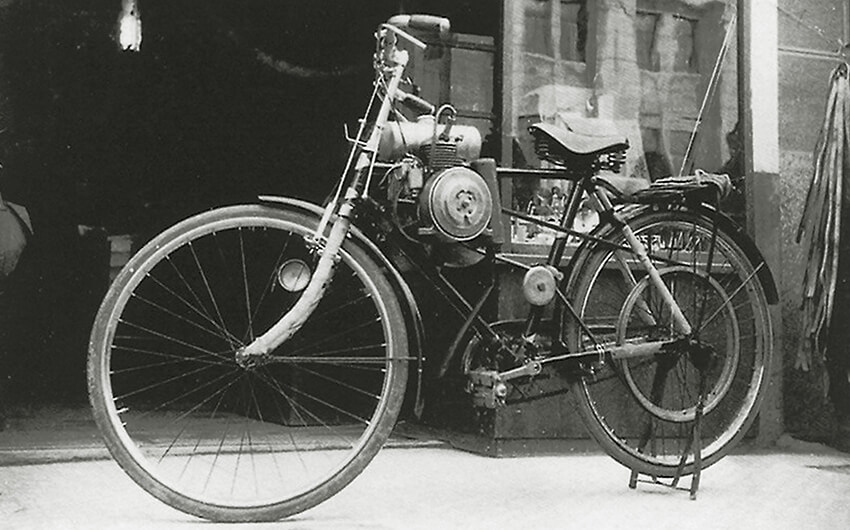
A bicycle fitted with an auxiliary engine.
In 1946, immediately following the end of the war, he founded the Honda Technical Research Institute with the aim of pursuing research and manufacturing of internal combustion engines and various machine tools. That very year, he stumbled across a cache of small engines that had been used as generators to power radios for the former Imperial Army. An idea immediately popped into Soichiro’s mind:
“I can use these to power bicycles!”
He started right to work creating a prototype motorized bicycle, spending all his spare time working away on the
engine as his eyes lit up at the thought of its potential. Eventually, he brought the prototype home and asked
his wife to take it for a spin. “I just made this for you. Here, why don’t you try it out?,” he said.
Since she knew she would have to ride down the main street of Hamamatsu, where many people would be watching, his wife put on her best pair of monpé trousers (Japanese women’s work pantaloons). Soichiro’s wife turned out to be Honda’s very first female test rider.
After riding all the way to Hamamatsu Station and home again, she was shocked to discover that her best pair of monpé were now covered in oil. The reason for this splattering of oily soot was that the unburned fuel/oil mixture had been blowing back through the carburetor. Sheepishly accepting his wife’s judgment that “this will never do; your customers will come back and yell at you,” Soichiro made scrupulously sure that the problem was fixed by the time he was ready to put the bicycle engine on sale.
Word of Honda’s auxiliary bicycle engines spread like wildfire, and their excellent reputation soon resulted in people from as far away as the big cities of Tokyo, Nagoya and even Osaka traveling all the way to Hamamatsu to buy one. However, as his stock of radio generator engines was running out, Soichiro quickly set about making his own auxiliary engine.
The Honda A-Type, Honda’s first totally original product, went on sale in 1947, and soon won a wide following for its affordable price, as well as its ability to run on the poor-quality fuel available at the time.
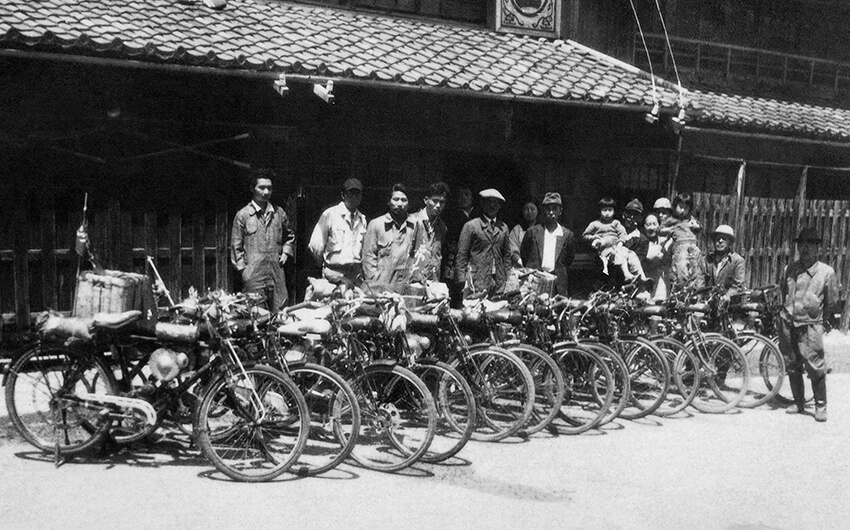
With the introduction of the A-type, a farewell ceremony was held for the bicycle-mount auxiliary engine.
Founded as a small factory in the town of Hamamatsu, with a starting capital of 1 million yen and 34 employees, Honda’s main product was an auxiliary engine for bicycles. This small company soon became the Honda that we know today.
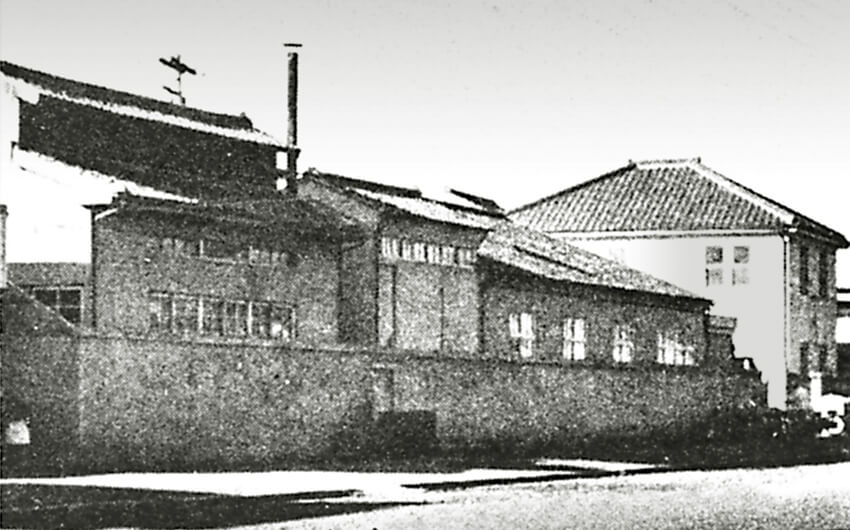
The Honda A-type was produced at the Yamashita factory in Hamamatsu.
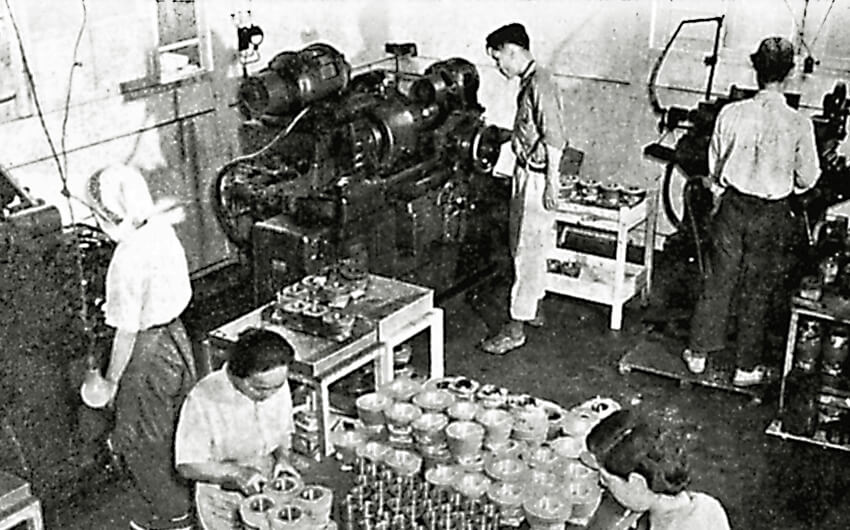
The A-type being assembled at the Noguchi Factory in Hamamatsu.
In 1952, four years after the founding of Honda Motor Company, Honda released the Cub F auxiliary engine, which was half the weight of its predecessors while offering significantly better riding and operating performance. Featuring bright red body coloring and a slim white tank, the Cub F also sported a fresh, attractive design. Easy to install even for bicycle shop owners who had no previous experience with engines, the Cub F went on to be sold by 13,000 shops nationwide and reached every corner of Japan.
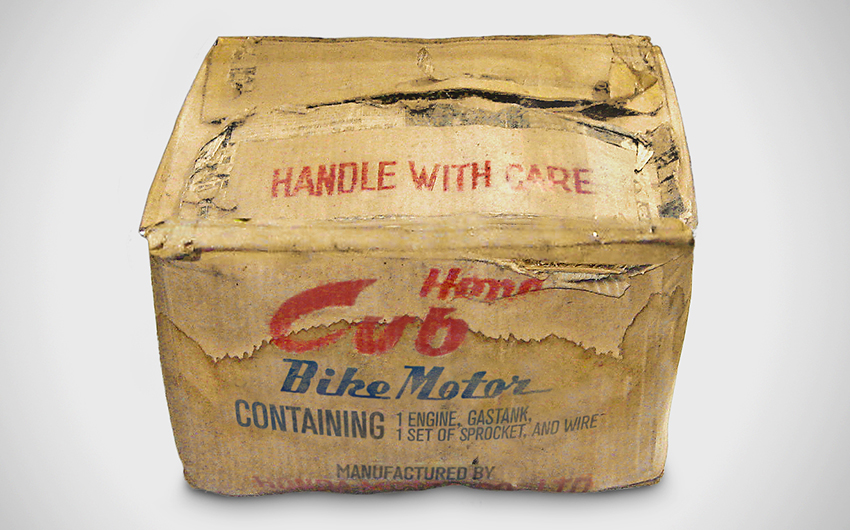
The Cub F was packaged and shipped in a specially designed cardboard box.
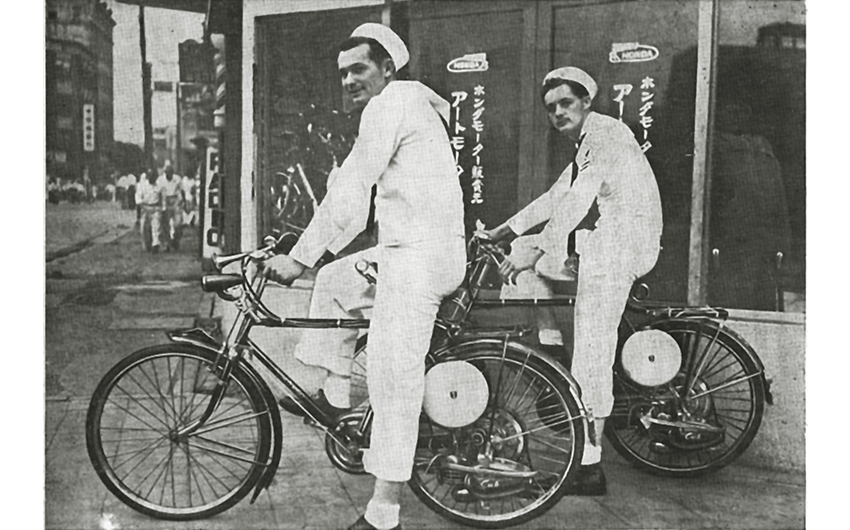
The Cub F became popular with everyone.
In a 1951 issue of Honda’s in-house magazine, Soichiro announced the concept of ‘The Three Joys:’ the Joy of
Creating, the Joy of Selling, and the Joy of Buying, which soon became the fundamentals of Honda’s philosophy.
“When I see someone with a problem, I just have to do something for them. I want to make people happy. Always
putting people first, I want to make their lives better through technology.” Honda’s subsequent general-purpose
products, including its tillers, lawnmowers, power generators and pumps, became important parts of people’s
lives, reducing labor with technology and making people happier.
(Source: Honda History: Fifty Years of Challenges, Honda Motor Co., Ltd.)