1950 – 1960
In the early 1950s, the chaos of Japan’s post-war years gradually gave way to a steady recovery. But there were still vast challenges ahead, such as increasing food production and building new infrastructure. In the midst of all this, Honda had enjoyed excellent success with its bicycle-mount auxiliary engines. Despite being tiny engines, they were able to make an important contribution to society.
It was around this time that Honda was contacted by a compact farm machinery manufacturer that had heard about the A-type and Cub F engines, and wanted Honda to provide a small engine for a portable sprayer.
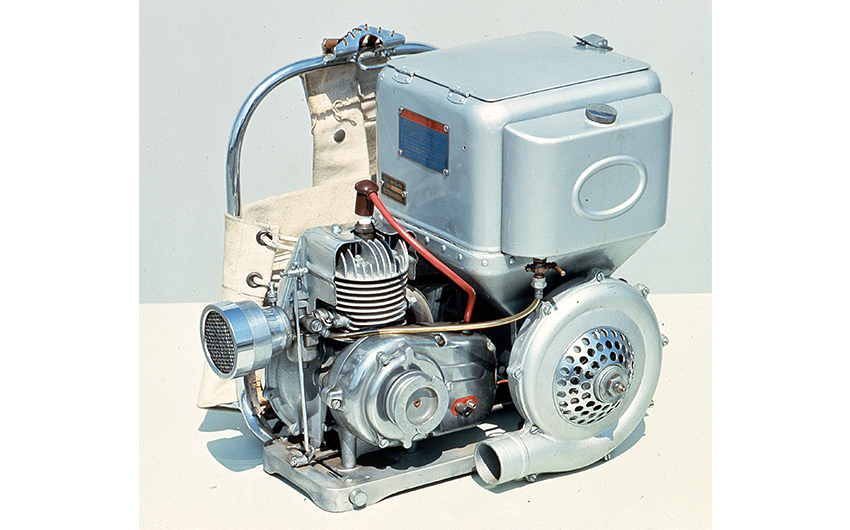
A backpack-type insecticide duster powered by the H-type engine.
Honda took on this request to develop a compact 2-stroke model that it completed late in 1952 and released in 1953 as its first-ever general-purpose engine. This engine was called the H-type.
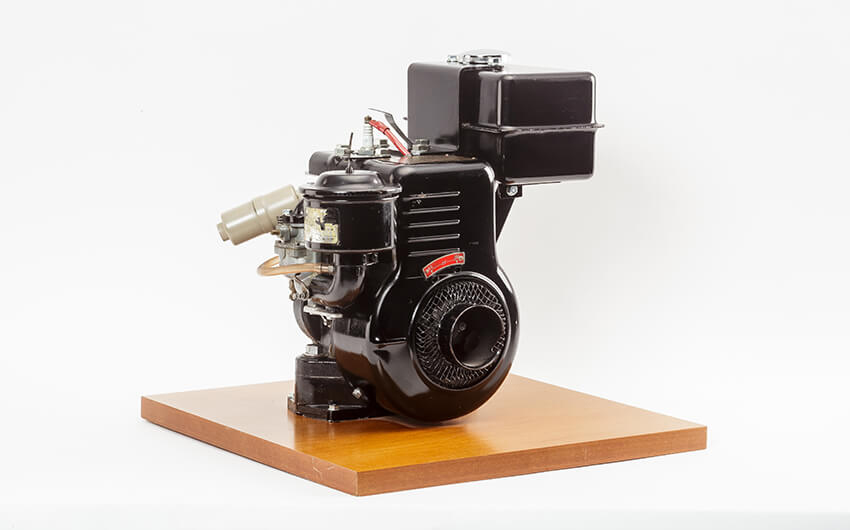
The T-type: Honda’s first 4-stroke general-purpose engine.
With an output of only 1 horsepower, the H-type was designed to be as compact and lightweight as possible, and was manufactured using aluminum die-casting, a cutting-edge technology at the time. It was also highly rugged and durable, and could be used for water pumps or power sprayers that could be carried on one’s back, thus helping to lighten the workload of farming.
The lightweight and compact H-hype engine also won an excellent reputation. Still, users continued to ask for improvements, like making it easier to start, quieter and easier to maintain. People also wanted it to be easier to use and not so grimy to handle.
These voices were answered by the T-type engine, which Honda released in 1954. A 2.5 horsepower 4-stroke model, the T-type provided rugged performance at low operating speeds combined with high output at higher revs for an impressive range of versatility when used to power a wide variety of farm machinery.
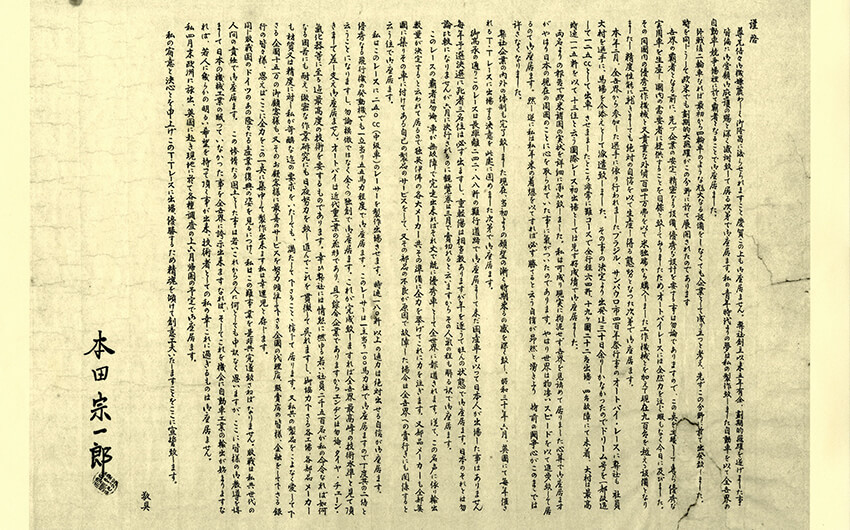
Honda’s declaration of future participation in the Isle of Man TT Races.
The year 1954 was also the year that Soichiro Honda declared his intention to participate in the U.K.’s Isle of Man TT motorcycle races. Besides taking on the world by “focusing all of Honda Motor Company’s efforts on winning the crown,” he also had his eye on Japan’s future, announcing that “Honda’s mission is the enlightenment of Japanese industry.”
Honda’s general-purpose engines went from use solely in agricultural and construction machinery to a broad range of applications, including ordinary household implements. As the world continued to change around it, even more power was demanded of its engines. In parallel with such demands were other areas where Honda could show its technological development skills, such as achieving both lower noise and vibration, as well as reducing engine exhaust temperatures.
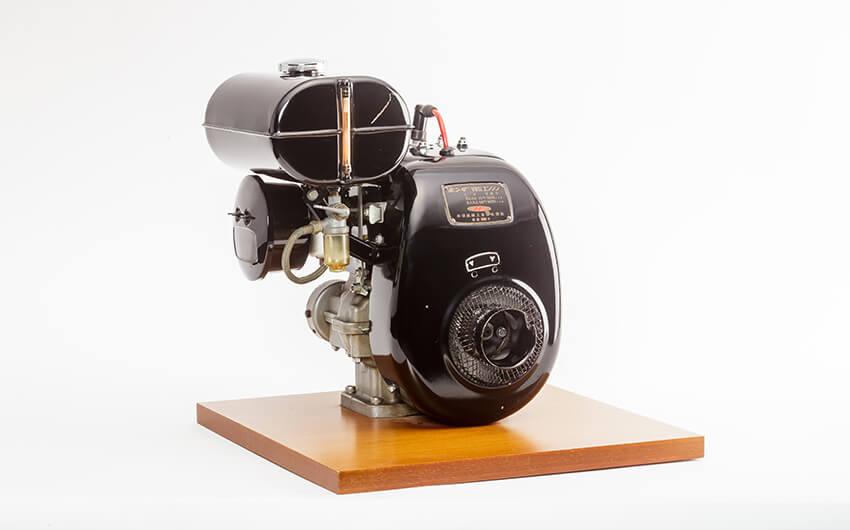
The more powerful VN engine.
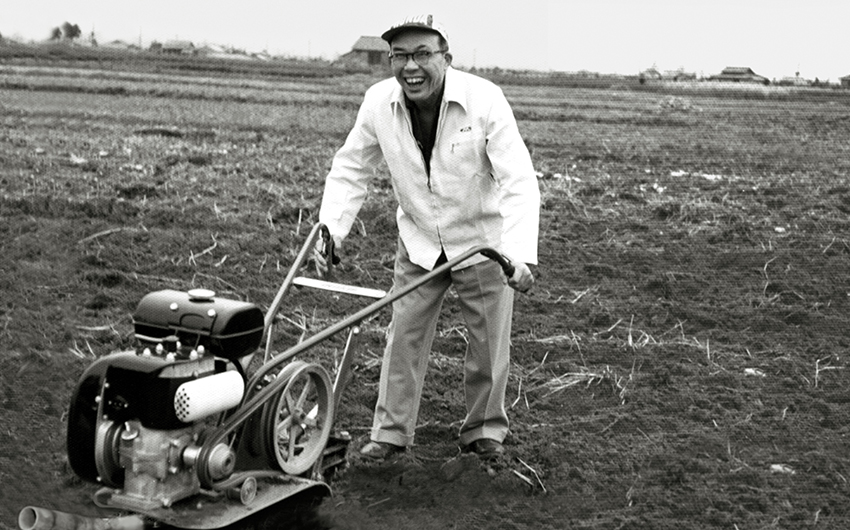
Honda Soichiro tests a new tiller powered by the VN engine.
In 1958, four years after the release of the T-type, Honda released its new high-quality, high-performance VN Series (VNC & VND) of general-purpose engines, with a maximum output of 5 horsepower, as a rugged and dependable power source for use in both agriculture, which was experiencing rapid growth in mechanization, and the construction industry, which was booming with increasing efficiency and productivity. This was the same year that the revolutionary Super Cub motorcycle made its debut, and also the point at which the Honda Motor Company shifted from its founding years into a new era of historic breakthroughs.
Soichiro Honda’s constant desire to provide products that could be more useful and easier to use had led the company to build the A-type and Cub F bicycle-mount auxiliary engines. It then graduated to building the general-purpose H-type and T-type engines. However, now Honda could no longer be satisfied with simply supplying engines to other manufacturers.
In the late 1950s, only 6% of Japan’s approximately 6 million farming households owned a motorized cultivator. At the time, people were starting to say that “These days getting married in rural areas depends entirely on whether or not you have a tiller.” To find a solution to this situation, Honda concentrated on developing a complete product based on one of its compact engines. First, a prototype was made using the VNC engine.
In this way Honda’s research and development shifted with the coming of the 1960s to fully developed cultivators and generators made using its own general-purpose engines.