Lawnmowers
These days, lawnmowers are common home and garden tools in both the USA and Europe. Even back in the 1970s they commanded a huge market, with global sales of over 8.5 million, of which more than 5 million were sold in North America.
However, lawnmowers of the time often had starting issues, and many were prone to breakdowns. There were safety issues as well. If not used properly, a lawnmower with a fast-spinning cutting blade could cause serious injuries. Yet, most lawnmower models of the time had virtually no safety features. This led to a lot of accidents, particularly when users tried to remove grass stuck in the cutter housing without first stopping the engine. Consideration was given to creating legislation that would require safety devices, but the many technical problems that arose meant that such legislation ended up being shelved. Still, more people demanded lawnmowers that were safer and easier to use.
Around this time, lawnmowers were still a rarity in Japan. Because of this, new lawnmower development was quite a challenge for Honda. The first step was prioritizing research into actual on-site conditions. So in addition to investigating usage environments and listening to user requests, Honda also collected and actually cultivated various varieties of grass lawns. These investigations were thorough enough that everything from grass growth to mowing conditions through to the disposal of cut clippings was taken into consideration.
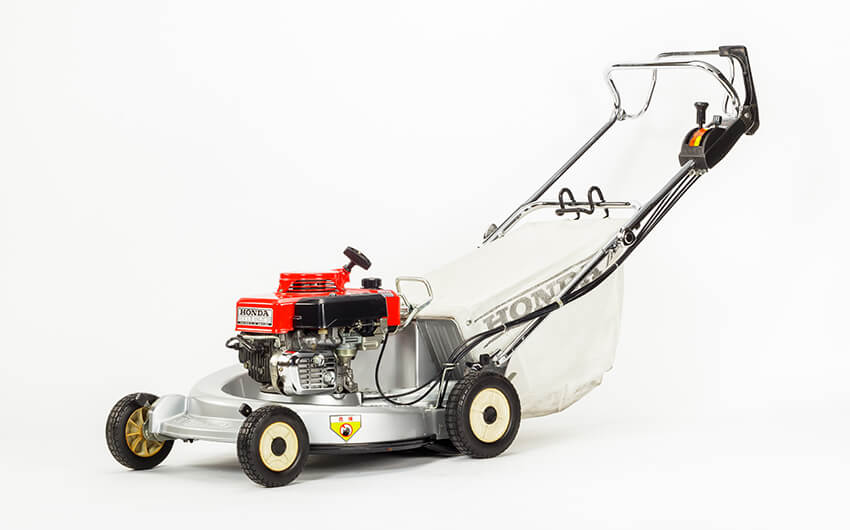
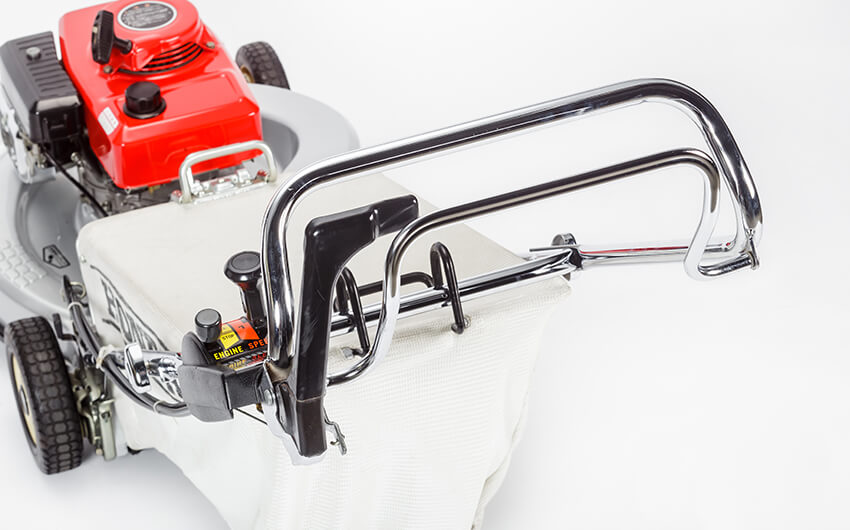
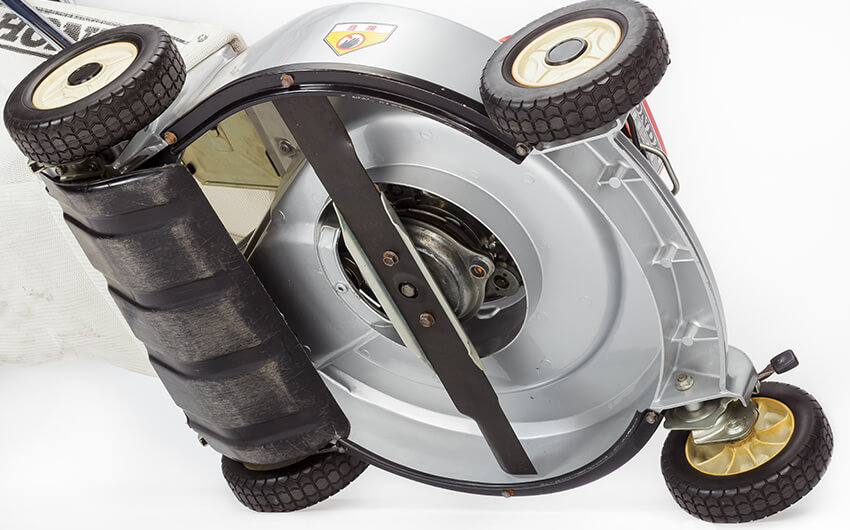
Honda’s first lawnmower, the HR21, featured a BBC (Blade Brake Clutch) mechanism, vacuum action, and a host of other innovations.
Research and development progressed based on these investigations, leading to the 1978 release of Honda’s very first walk-behind lawnmower, the HR21.
The HR21 featured a ‘vacuum action mechanism’ which generated a strong flow of air through its the blade rotation that would lift bent-over blades of grass, making it easier to mow. Users could also easily select which of three types of mowing they wanted to perform. The first scenario was ‘Bagging,’ where the large amounts of mown grass thrown up by the mower were collected in a grass bag to be emptied and discarded. The second scenario was ‘Discharge,’ which in case of continuous work simply discharged the mown grass from the lawnmower to be collected later. The third scenario was ‘Mulching,’ in which short grass was finely cut and the chopped clippings dropped back onto the ground.
To make the HR21 easier to use, its lawnmower controls were all positioned close to the hands as they rest on the handle. Honda’s GV150 engine was specially selected to power the HR21 owing to its excellent starting ease, durability, and quiet operation.
The HR21 also featured Honda’s original Blade Brake Clutch (BBC) mechanism, which was developed based on an active desire to advance and promote safety aspects. This technology placed a prime consideration on safety, so the cutter blades would only rotate while the clutch lever was gripped. Releasing the clutch lever would cause a brake to engage and quickly stop the rotating blades within about 3 seconds.
This BBC mechanism not only took into consideration user safety, it also featured enhanced user convenience. Basically, the engine could continue running even when the cutter blade was stopped, so the user didn’t have to go to all the trouble of constantly stopping and restarting the lawnmower every time the grass bag had to be emptied. Honda’s innovative BBC mechanism was the world’s first safety device for lawnmowers. Its very existence encouraged the promotion of safety standards for lawnmowers in the USA, while making a major leap forward for safety in the use of walk-behind lawnmowers.
Honda’s high-quality, high-safety walk-behind lawnmowers soon became a major hit all over the world, including Europe, which eventually led to the company opening a lawnmower factory in the United States in 1984, followed by factories in France, Australia and other countries. To this day, Honda continues to try to meet the needs of local consumer demand.
These novel HR21 lawnmower features correctly anticipated local needs. However, they originated from the combination of Honda’s technological capabilities along with the Japanese propensity for focusing on fine details. Results included not only beautifully mown lawns, but also a greater degree of user friendliness and a high commitment to safety.
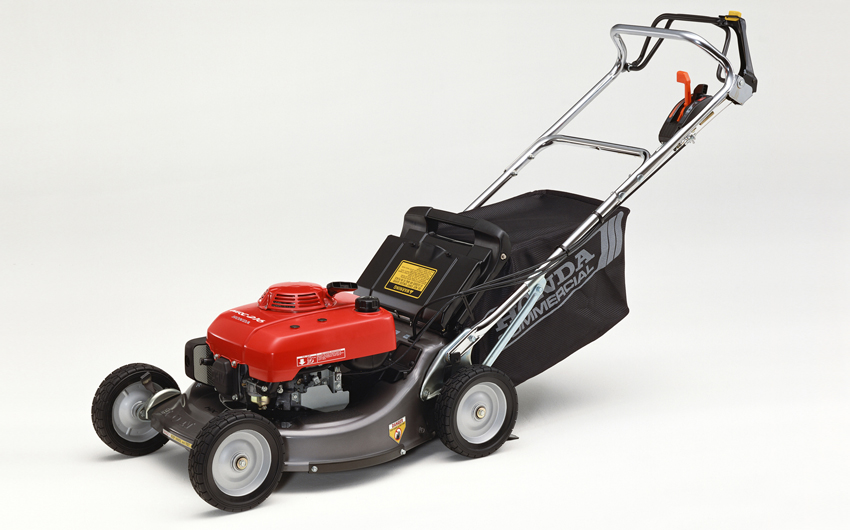
The 1990 HRC216 was the world’s first lawnmower to incorporate the HST hydrostatic transmission.
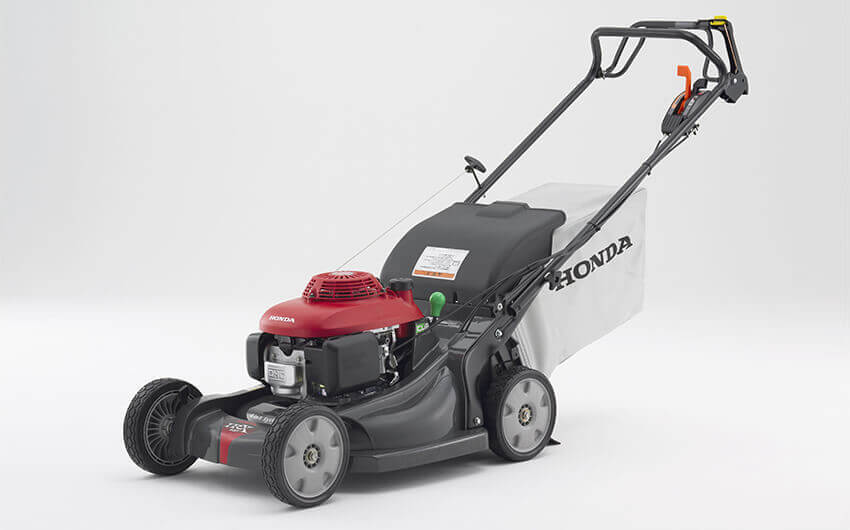
In 2005, the HRX537 added a leaf shredder function.
The basic configuration and functions of the HR21 were carried forward with further refinements and improvements that turned up in subsequent models. The engine was replaced with an improved model, while Honda continued to add more original features in areas other than basic lawn mowing functionality. Examples include the Hydro Static Transmission (HST), which allows users to change speeds while mowing, the Variable Speed Transmission (VST), which allows users to control the mower’s speed with a single lever, a hard-plastic housing (cover) that is both lightweight and durable, and an automatic choke that greatly simplifies engine starts.
Further additions included the Variable Mulching System (VMS), which made it possible to quickly shift mowing operation from bagging to mulching, and the Leaf Shredder kit designed to mulch both cut grass and fallen leaves.
In terms of operability, Honda’s lawnmowers continue to evolve through the adoption of the latest technological improvements. These include the Smart Drive system, which allows speed adjustments to be made with even easier operation, and Select Drive (released in 2015), which uses a handy dial to set the top speed, etc.
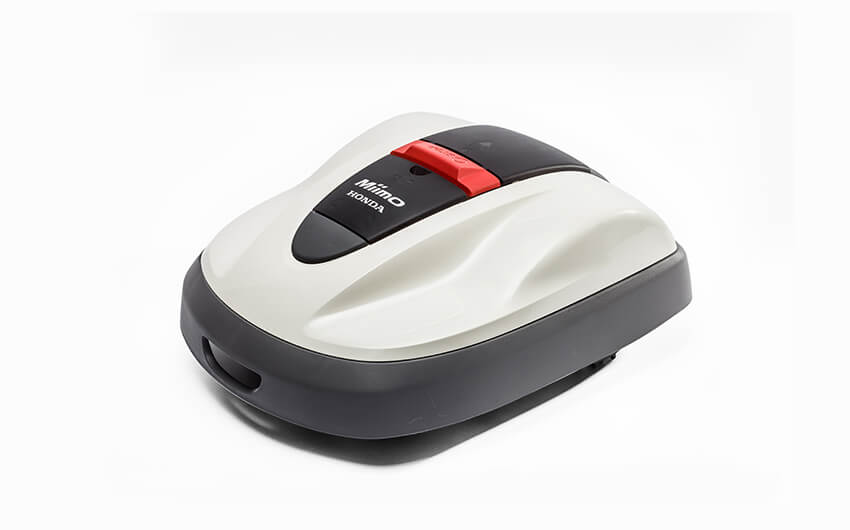
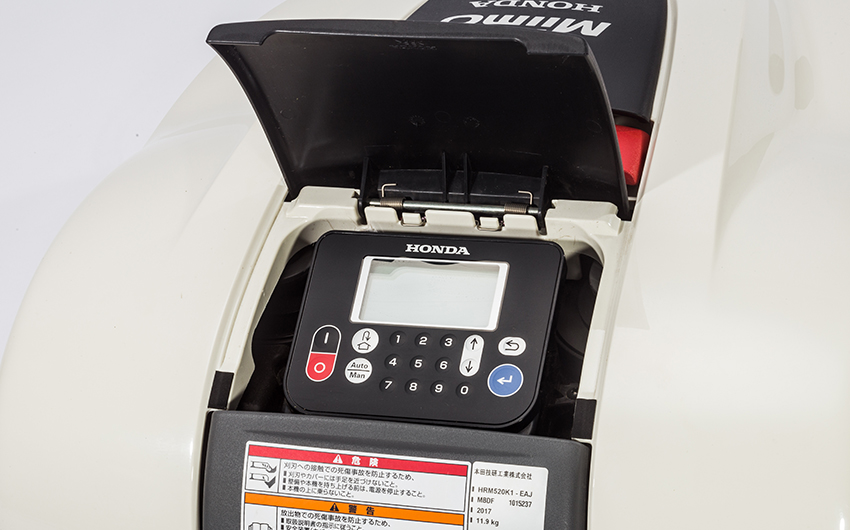
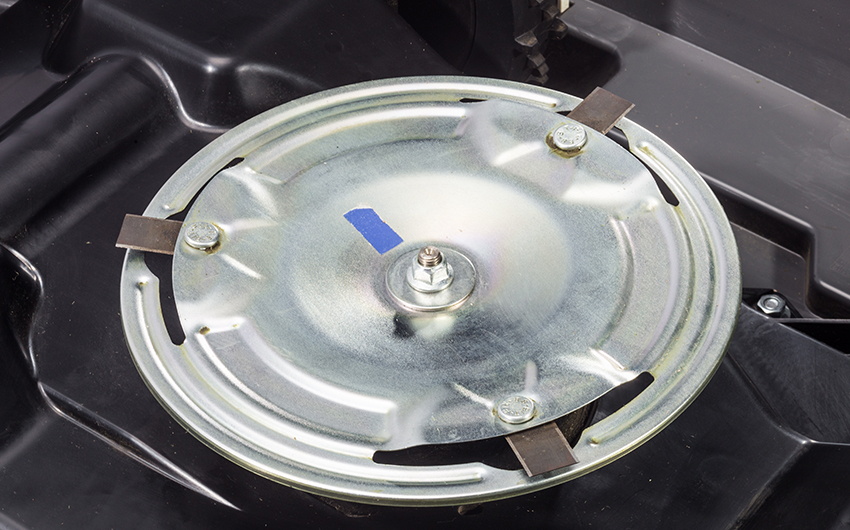
The fully automatic Miimo could be easily programmed to keep lawns trimmed.
In response to changing circumstances, such as those inspired by ongoing trends like our aging societies and diversified leisure time, robotic lawnmowers began to appear in Europe as we entered the 21st century. In 2012, Honda released its new fully automatic robotic lawnmower, called the Miimo, in Europe (Japan release: 2017).
Miimo was developed with three basic concepts in mind: autonomous reliability (for a high degree of safety), ease of use (for simple operation), and the ability to enjoy an enhanced quality of life (through its high quality and durability). Though Miimo was a late entry to the field of robotic lawnmowers, its high degree of technological capabilities gave it an edge over existing manufacturers.
Boundary wires placed on a lawn are used to mark out Miimo’s work area. Miimo receives signals from these perimeter wires that allow it to recognize where it is supposed to mow. Other robotic lawnmowers use a similar system, however the quality of the signal received makes a big difference in the quality of the work carried out by the mower. Honda developed its own high-quality control signal, which carefully takes into account the effects of surrounding devices to ensure that Miimo continues its work without interference.
Miimo’s development also takes safety aspects into serious consideration. If for any reason the unit turns over or is lifted up, the cutter blades are automatically forced into an emergency stop. If Miimo bumps against something, it avoids the obstacle on its own and restarts its work. All the sensors that detect these changes are installed in pairs in a redundant backup system. Therefore, should one sensor ever fail, the other will detect this failure to enable the device to come to a safe stop.
Although Miimo does require the input of a simple program, once completed it automatically carries out its works optimally and efficiently. The program directs Miimo to patrol the lawn area, regularly cutting areas of growth and returning the finely cut grass to the lawn as mulch. So no collection of grass cuttings is required. When it needs to recharge, it returns to its charging station by itself, then restarts its work once its battery is fully charged. Miimo is also completely waterproof, so it doesn’t have to be taken inside even when the weather is rainy.
Miimo has three modes of mowing operation: random, directional and mixed. It can climb slopes up to 25 degrees and has excellent traverse motion (moving diagonally up a slope) capabilities, enabling it to continue to cut efficiently without undue influence from changes in flat and sloping ground.
Honda also put a lot of thought into Miimo’s exterior styling. Instead of an aggressive angular look, its gently curved design makes it look like a pet moving across the lawn, which is also one of its most appealing features. Miimo has won an excellent reputation in Europe thanks to its safety considerations, high quality and performance, and has recently been released in Japan and North America.
Honda offers a wide variety of lawnmowers that take the extra step to meet the needs of our customers. Our walk-behind lawnmowers have a well-established reputation with lawn care hobbyists due to their practicality, while Miimo is able to maintain lawns in their most ideal condition by constantly patrolling them 24 hours a day, 365 days a year.
The concept of ‘making people happy through technology’ has remained the central philosophy of Honda’s power products since the release of its H-Type engine in 1953, helping to ease the burden of human labor and free up valued time. Fully automated lawnmowers like the Miimo, which work automatically in place of an individual, are the true embodiment of the goal of Honda Power Products. But this is by no means the endpoint; rather it should be seen as the start of a new age of even higher quality and more efficient lawn mowing equipment.