Engines
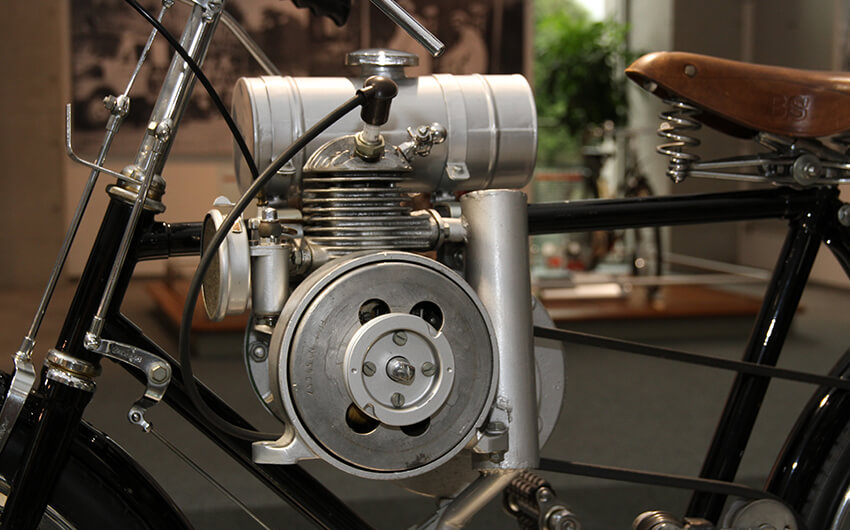
This bicycle-mount auxiliary engine won fame for its few breakdowns.
Soichiro Honda’s very first bicycle-mount auxiliary engine was developed and released in 1946. Having acquired a large consignment of engines that had been originally designed to power army radios, Soichiro modified them so that oil and exhaust fumes would not dirty the clothes of the rider. Every part was dismantled and cleaned prior to shipping, and the bicycles were test-ridden after reassembly. In those days of postwar poverty, it would have been enough for the bicycle to simply move. However, no effort was spared in making sure these engines were easy to use and breakdown-free.
This led to Honda’s engines quickly gaining a reputation for running well with a minimum of failures. Soon, that initial consignment of 500 engines ran out, prompting the development of a new engine. Honda’s first completed engine was dubbed the “A-type,” an air-cooled two-stroke 50cc single-cylinder type.
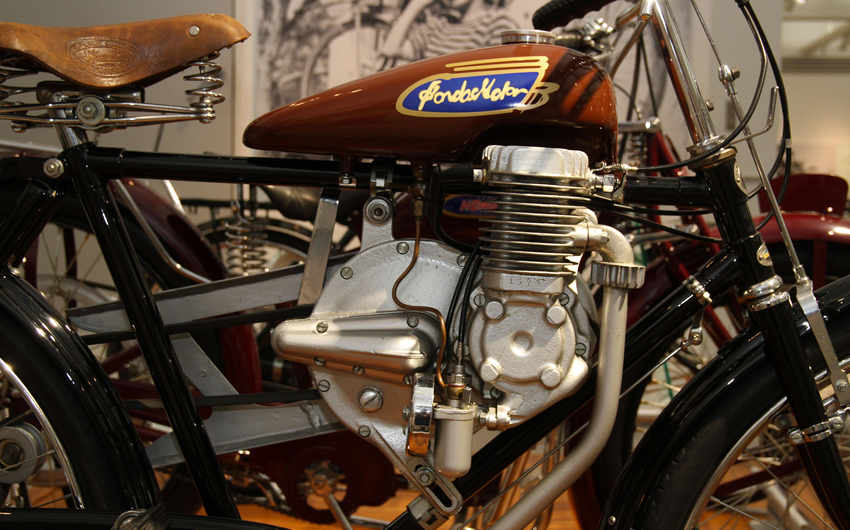
The A-type engine became renowned for being easier to handle and less prone to breakdowns.
The new Honda A-type was specially designed with die-cast construction. Die casting had the merits of reducing the number of parts, as well as the number of production processes, and greatly reducing the volume of waste metal shavings. However, at the same time the huge initial investment costs to gear up for mass production seemed reckless for such a small-scale factory. Still, with priority given to reducing the weight of the engine as well as reducing the number of production processes and parts to effectively keep down costs, the decision was made to adopt die-cast production.
Just as planned, the Honda A-type ran exceedingly well, and with a minimum of breakdowns. Careful attention was paid to incorporating safety features into its design, such as placing the exhaust pipe, which could become extremely hot, in line with the frame to discharge exhaust fumes downward. The nuts and bolts in common use at the time suffered from a poor degree of precision and often came loose. Honda introduced new innovations in key locations to prevent troubles from arising if a nut ever worked loose. The Honda A-type was also designed so that it could be disassembled without the need of special tools, and it soon won an excellent reputation at the bicycle shops that handled it.
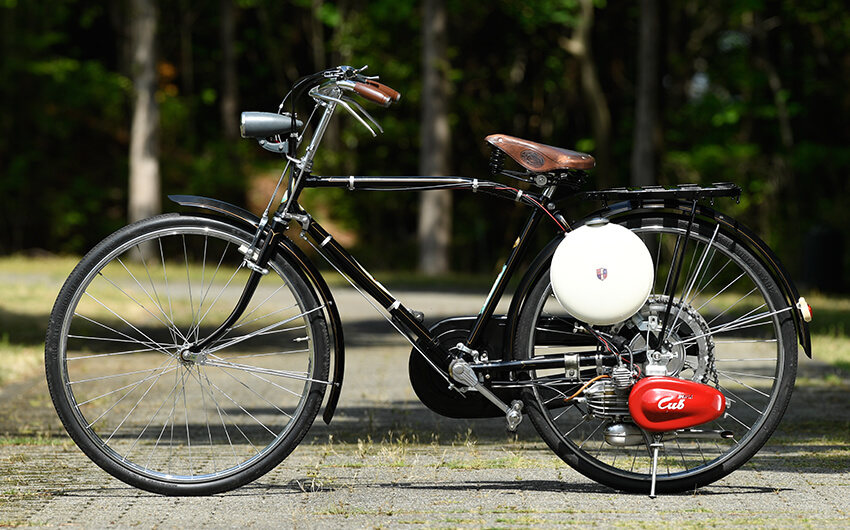
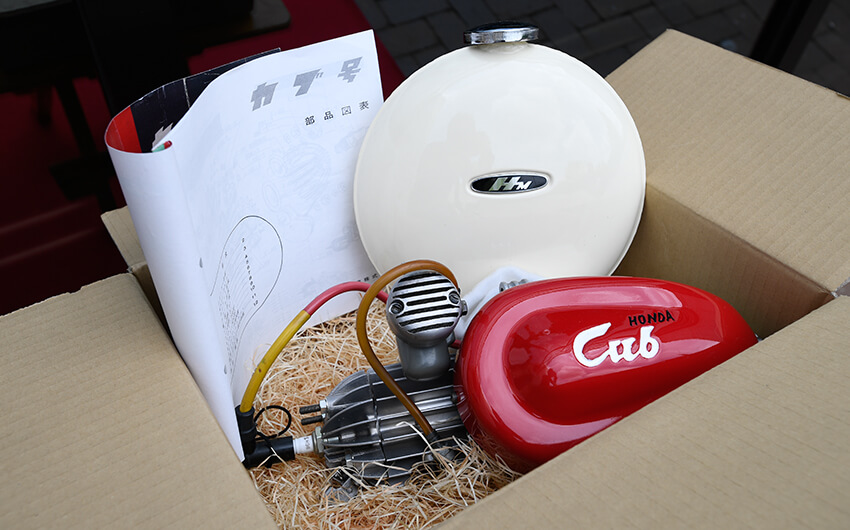
The easy-to-install Cub F also became a colossal hit.
The Honda A-type auxiliary engine was produced through to 1951. Its successor, the Cub F bicycle-mount auxiliary engine, was designed with special consideration given to being simpler, easier to use, and even more durable. At 25,000 yen—then roughly three months starting wages for an average white-collar worker in Japan—the Cub F was high-priced for a bicycle engine. However, Honda’s reputation for excellent quality transcended price, and based on its reliability and ease of use, this meant that people were willing to pay more for a Honda product, pushing sales to over 25,000 units in its first year of production.
By the time the Cub F was released in 1952, seven years had passed since the end of the war, and the recovery of the Japanese economy was steadily progressing.
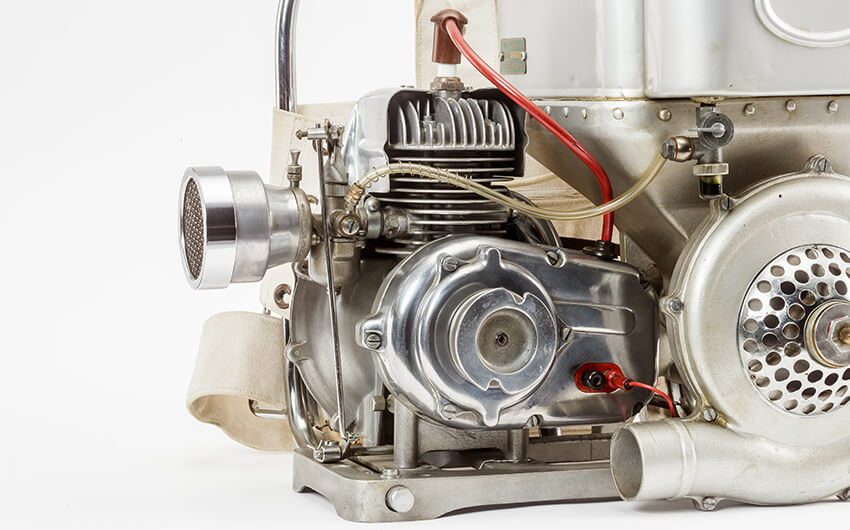
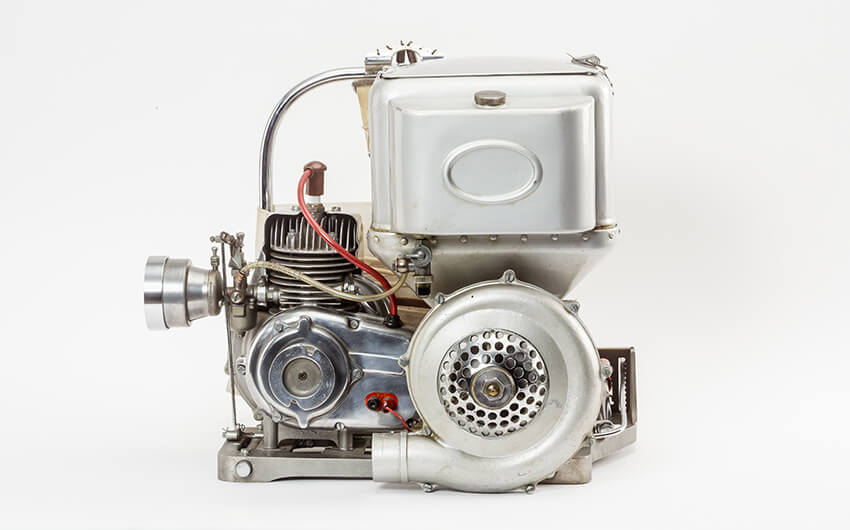
Honda’s first general-purpose engine, the H-type, was developed to power a backpack-style crop dusting machine.
Industries like construction, agriculture and fishing were shifting more and more away from human labor to mechanization. Later that year, in September of 1952, Honda announced the release of its first general-purpose engine, the H-type, a forced air cooled, 2-stroke 50cc single cylinder that put out 1 horsepower.
The H-type’s main component parts were formed of die-cast aluminum, making possible a lightweight and compact engine that weighed a total of 6kg. As starting up most engines of the time was often hard work, its double-pull rope-type manual starter was well received. The H-type was also OEM supplied as an engine for powering backpack insecticide dusters, of which over 5,000 units were exported to coffee plantations in Brazil.
At the time, the vast majority of general-purpose engines were either noisy, vibrating 2-strokes that gave off noxious fumes, or big, heavy and hard to handle liquid-cooled diesels, which ran on smelly kerosene. By switching to a 4-stroke configuration, reduced vibration, better fuel economy, and far fewer unpleasant smells could all be realized, while greatly improving long-term durability. On the other hand, the actual manufacture of the engine would necessarily be more complicated, resulting in higher costs.
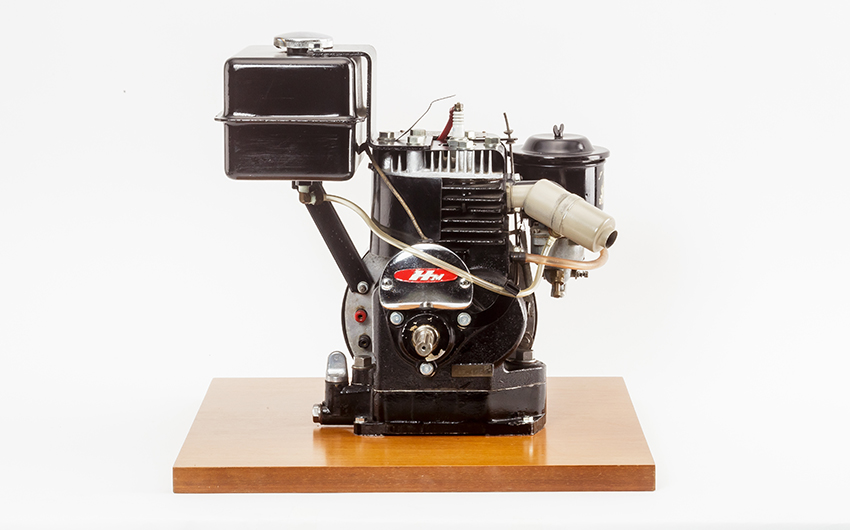
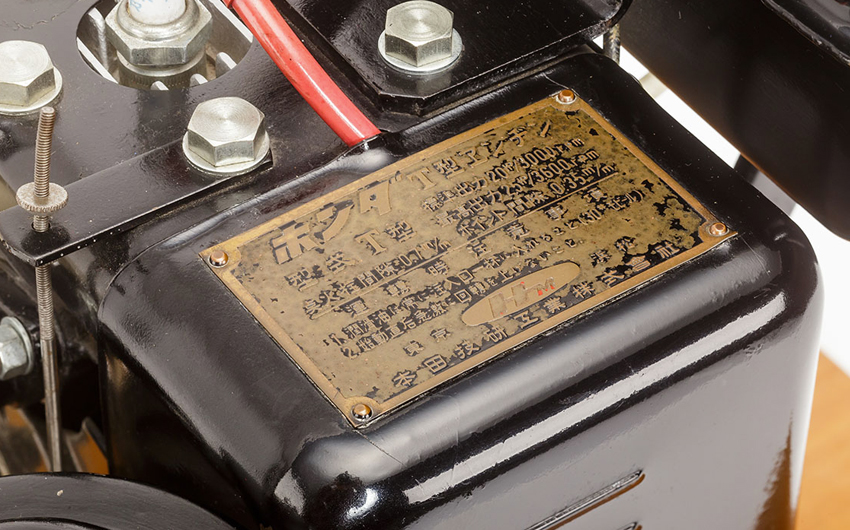
The T-type 4-stroke engine.
Honda took up the challenge of creating a 4-stroke engine that could be easily used by farmer’s wives. In December of 1954, the company launched its T-type farm engine, a compact power source that could be easily used by people who had no prior experience handling engines.
With power output increased to 2.5 horsepower, the T-type was designed to perform reliably even when mounted on farm machinery at an angle, and was equipped with Honda’s first in-house developed carburetor. Its muffler was also designed to not discolor when exposed to high temperatures, enhancing the look of the product as well as its ease of use.
Japan’s economic growth began to surge in the 1950s. Young people from poor farming villages started to pour into the cities as labor. The sudden decrease in the number of young people on the farms resulted in them being run more and more by “mom, grandpa and grandma.”
In 1953, the Agriculture Mechanization Promotion Law was enacted in order to promote greater agricultural productivity and improve agricultural management. By 1956, self-feeding threshers were in use by over 2.7 million farms, half the total number of farming households in Japan. The mechanization of farming steadily progressed as the labor force continued to dwindle.
The market for agricultural machinery in Japan was soon monopolized by a small number of specialist manufacturers, leaving little room for new manufacturers to enter.
At the time, the farm machinery market was dominated by large, heavy, and troublesome ‘professional use’ items, with few farm tools to be found that farmers wives could easily use.
Under these circumstances, Honda’s idea of wanting to “put a Honda-powered product in each home to reduce labor and increase productivity, and make Japan a richer country” was further strengthened by the establishment of a new Agricultural Machinery Design Division in 1958.
Rather than being content with merely building engines, Honda was taking its first steps in developing and creating finished products that would become integral parts of people’s lives. Of course, the essential idea was always to “make people’s lives better through technology.”